The network effect
Abstract
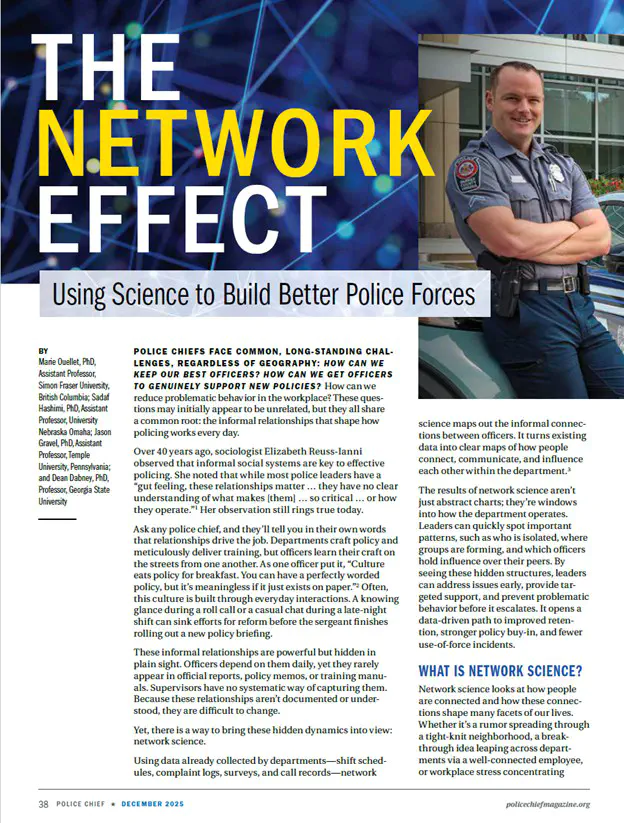
Police chiefs face common, long-standing challenges, regardless of geography: How can we keep our best officers? How can we get officers to genuinely support new policies? How can we reduce problematic behavior in the workplace? These questions may initially appear to be unrelated, but they all share a common root: the informal relationships that shape how policing works every day. Using data already collected by departments, shift schedules, complaint logs, surveys, and call records, network science maps out the informal connections between officers. It turns existing data into clear maps of how people connect, communicate, and influence each other within the department. The results of network science aren’t just abstract charts; they’re windows into how the department operates. Leaders can quickly spot important patterns, such as who is isolated, where groups are forming, and which officers hold influence over their peers. By seeing these hidden structures, leaders can address issues early, provide targeted support, and prevent problematic behavior before it escalates.

Marie Ouellet
Assistant Professor
Dr. Marie Ouellet’s research focuses on delinquent groups, including how they emerge and evolve, and how networks structure this process. She is currently leading a longitudinal study on police networks to better understand the informal structure of policing, including organizational cohesion and fragmentation within departments, and the consequences of these network structures on the diffusion of behaviors and attitudes. Ouellet’s work has been published in Criminology, Criminology & Public Policy, Journal of Research in Crime and Delinquency, and Justice Quarterly.

Sadaf Hashimi
Assistant Professor
Dr. Hashimi’s research centers on issues pertaining to policing and policy, peer influence and crime, and violence prevention efforts. Specifically, Dr. Hashimi employs social network analysis and various other research designs to uncover patterns of criminal and non-criminal behaviors that relate to co-offending, police misconduct, police use of force, and gang involvement.
Jason Gravel
Assistant Professor
Dr. Gravel’s research focuses on the application of social network analysis in many areas of criminology and criminal justice research, most notably in the study of street gangs, co-offending, gun violence, and police misconduct.
Dean Dabney
Professor
Dean Dabney is a Professor in the Department of Criminal Justice and Criminology at Georgia State University. He received his doctorate in sociology from the University of Florida in 1997 and has been on faculty at GSU since then. His research agenda is principally focused on the study of police culture and their efforts to combat violent crime. In recent years, he has studied the operation of homicide units, the use of confidential informants, police response to gun violence, and officer use of discretion.